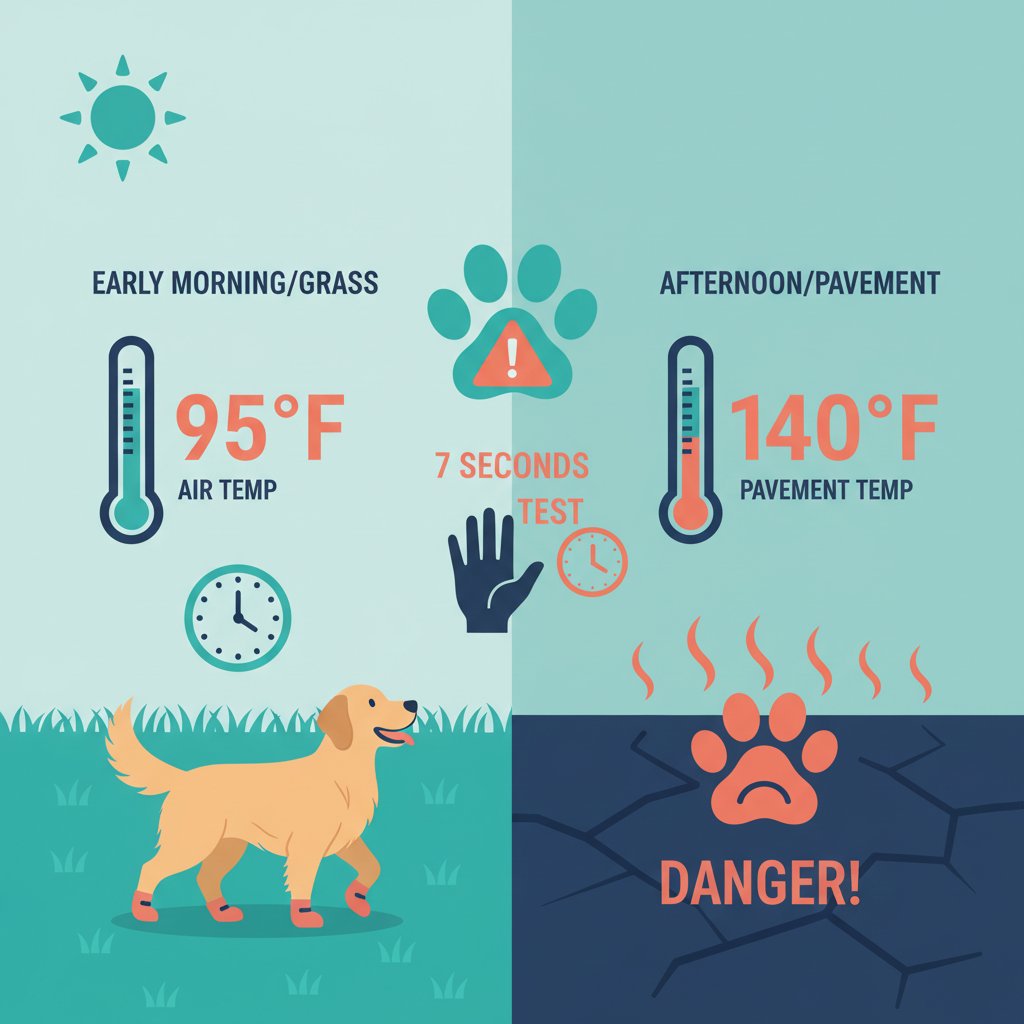
If you walk your dog in Largo during the summer, the temperature on the ground is not the same as the temperature in the air. That gap is the single most underestimated danger for dogs in Pinellas County, and it does not take a heatwave for it to become a problem.
This guide breaks down the actual data behind pavement temperatures, paw burn thresholds, and safer walking windows — with sources so you can verify every number yourself.
The core problem: pavement holds heat much longer than air
Asphalt and concrete absorb solar radiation throughout the day and radiate it back upward. Even after the air starts cooling down in the late afternoon, hard surfaces stay dangerously hot for hours. A study-based comparison from the University of Georgia Cooperative Extension found that at an air temperature of 95°F, blacktop asphalt can reach 140°F on the surface — a 45-degree difference. [1]
📊 Key takeaway: When the air hits 95°F in Largo, the asphalt under your dog's paws can be 140°F. That is hot enough to cause thermal burns in under 60 seconds.
The surface temperature gap is not linear — it gets worse as the air gets hotter. Here is a comparison based on data from multiple veterinary and meteorological sources: [1][2][3]
| Air Temperature | Asphalt / Blacktop | Concrete | Grass (shade) | Paw Safe? |
|---|---|---|---|---|
| 77°F | 125°F | ~115°F | ~85°F | No |
| 86°F | 135°F | ~125°F | ~90°F | No |
| 87°F | 140°F | ~130°F | ~92°F | No |
| 95°F | 140°F+ | ~135°F | ~105°F | No |
| Before 8am (typical) | ~85–95°F | ~80–90°F | ~75°F | Usually yes |
That table is why timing matters more than almost anything else. The air might feel tolerable at 10am, but the pavement has already been baking for hours.
What pavement heat actually does to paw pads
Paw pads are not indestructible. They are living tissue with a tough outer layer, but that layer has limits. According to veterinary sources, surface temperatures above 125°F can begin causing damage to paw pad skin. At 135°F, burns can occur in about 60 seconds of continuous contact. At 140°F+, the outer layer of the pad can separate from the tissue underneath, leading to blistering, rawness, and extreme pain. [3][4]
Dogs do not always show pain immediately. A dog that is excited to be outside may keep walking on hot pavement long past the point where damage is happening. That is why checking the surface yourself matters more than reading your dog's body language.
Signs your dog's paws may already be burned
- Limping or refusing to walk, especially on hard surfaces
- Excessive licking or chewing at the paws after a walk
- Visible redness, darkening, or peeling on the paw pads
- Blistering or raw patches
- Pads that feel softer or look shinier than usual
If you see any of these signs, get your dog off hard surfaces immediately, cool the paws with lukewarm (not ice-cold) water, and contact your vet. Severe burns can become infected quickly. [3]
The 7-second test: the simplest tool you have
Before every summer walk, press the back of your hand flat against the pavement. If you cannot comfortably hold it there for seven full seconds, it is too hot for your dog's paws. [3][5]
This test takes less than 10 seconds, costs nothing, and catches the problem before it becomes an emergency. Do it at the start of the walk and again if you change surfaces — what is safe in the shade may not be safe in direct sun two blocks later.
Florida humidity makes cooling harder
In Largo and across Pinellas County, the heat danger is compounded by humidity. Dogs cool themselves primarily through panting, which relies on evaporation from the tongue and airway. When humidity is high, evaporation is less efficient, meaning your dog cannot cool down as effectively even if the air temperature seems manageable. [6]
This is why a walk that feels "okay" to you can still be dangerous for your dog. Humans sweat. Dogs pant. The two cooling systems work very differently, and Florida's humidity levels handicap the one your dog relies on.
Safer walking windows in Largo
Cornell University's Riney Canine Health Center recommends planning walks in the early morning or evening hours, and notes that the hottest part of the day is typically between 3pm and 5pm. [6] PetMD recommends avoiding walks between 10am and 4pm entirely during summer months. [7]
For Largo specifically, the safest practical windows are:
- 6:00–8:00 AM — the coolest and safest window. Pavement has had all night to release heat. This is why Spare Human Services starts visits at 6am.
- After 8:00 PM — once the sun is down and surfaces have had time to start cooling. Check the pavement first; it holds heat longer than you might expect.
- Avoid 10:00 AM – 7:00 PM — the highest-risk window for both pavement temperature and ambient heat.
🌡️ Florida-specific note: Largo's average summer high temperatures routinely exceed 90°F from June through September. At those air temps, asphalt can stay above 135°F well into the early evening. Always test before you walk. [1][8]
Practical strategies for safer summer walks
Good summer routes are not just about distance. They are about trees, grass, shorter loops, and easy return points if the dog starts struggling. Quiet routes are also better for dogs that get overstimulated around traffic or other dogs.
- Walk early. Before 8am is ideal. Before 6:30am is even better in peak summer.
- Choose grass and shade. Grass in the shade can be 30–50°F cooler than asphalt in direct sun. Even shaded concrete is significantly cooler than sun-baked blacktop. [1]
- Shorten the route. In summer, a safe 15-minute walk is better than a risky 45-minute one. Adjust based on your dog, not your schedule.
- Bring water. Offer water mid-walk, not just after. Hydration supports your dog's ability to pant and cool down.
- Consider booties. Protective footwear can help for dogs that need to walk on hard surfaces, though many dogs need time to get used to them. [3]
- Watch for overheating signs. Heavy panting, slowing down, glassy eyes, drooling, or refusing to continue are all warning signs. Stop, find shade, and cool down. [6]
- Adjust for your dog. Brachycephalic breeds (pugs, bulldogs, Frenchies), senior dogs, overweight dogs, and large breeds all heat up faster and cool down slower. [6]
Spotting overheating before it becomes an emergency
Heavy panting, slowing down, glassy eyes, drooling, bright red gums, or a dog suddenly refusing to keep walking are all warning signs. When that happens, stop the walk, get into shade, offer water, and focus on cooling down before symptoms escalate.
Large breeds, senior dogs, brachycephalic breeds, and overweight dogs all heat up differently. Some dogs can handle a short sniff walk and some need a fast potty break and straight back inside. The goal is not to force a full walk. The goal is a safe one.
Why this matters for reactive and large dogs
If your dog is reactive or a large breed, the summer heat adds an extra layer of risk. Reactive dogs that get overstimulated on busy sidewalks are already operating at a higher stress baseline. Add heat stress on top of that, and the situation can escalate faster than it would on a calm, cool morning.
Large breeds also generate more body heat and may be harder to manage if they start pulling or refusing to move. Early morning walks mean quieter streets, fewer triggers, cooler surfaces, and a safer environment for everyone — which is exactly why I build my schedule around 6am starts in the summer.
The bottom line
You do not need to stop walking your dog in the Florida summer. You need to walk smarter. The data is clear: pavement can be 40–50°F hotter than the air, paw pads can burn at 125°F, and the safest window is early morning. Test the ground, choose your timing, and when in doubt, shorten the walk and go earlier.
If you want help keeping your dog's summer routine safe and consistent, I offer early-morning dog walking in Largo, Clearwater, Seminole, Dunedin, and surrounding Pinellas County neighborhoods — built around the times that are actually safe for your dog to be outside.
Need a hand with your pet?
Dog walking, drop-in visits, overnight care, and more — serving Largo, Belleair, and Clearwater.
🗓️ Book Online NowOr call/text (727) 386-6349
Sources
- University of Georgia Cooperative Extension, How Hot Does Pavement Get in Summer? — Surface temperature comparison table at 95°F air temperature (asphalt 140°F, grass in shade 105°F). site.extension.uga.edu
- RexVet, Hot Pavement Paw Burns in Dogs: Summer Safety Tips (reviewed by Dr. Tiffany Delacruz, DVM) — At 87°F air temperature, asphalt can reach 140°F. rexvet.org
- RexVet (same source) — Paw pads can suffer damage at surface temperatures above 125°F; 7-second rule for testing pavement; protective booties and first aid guidance.
- American Animal Hospital Association (AAHA), How to Protect Your Dog's Paws from Hot Pavement — At 86°F air, asphalt can reach 135°F and burn paws in 60 seconds. aaha.org
- Four Paws International, Hot Asphalt – A Danger to Your Dog's Paws — The seven-second hand test for pavement safety. fourpawsusa.org
- Cornell University College of Veterinary Medicine, Riney Canine Health Center, Summer Heat Safety Tips for Dogs — Walk early morning or evening; hottest hours 3–5pm; overheating signs; brachycephalic and senior dog risks. vet.cornell.edu
- PetMD, 10 Summer Dog Walking Tips — Avoid walking between 10am and 4pm in summer. petmd.com
- Dr. Kathy's Veterinary Care (Largo, FL), Dog Summer Heat & Hydration — Keep dogs indoors during peak heat (10am–4pm); walk early morning or after sunset. drkathys.com